
· by Michael Blair, Nashville's Concrete
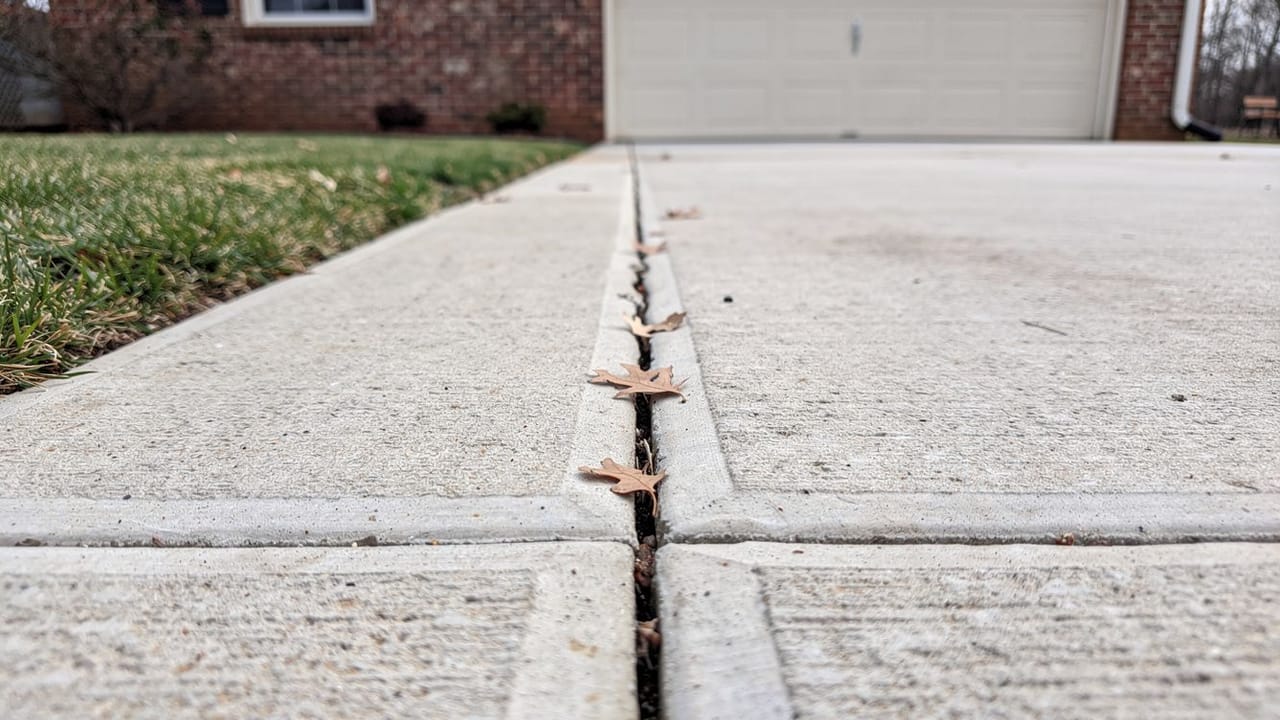
Every slab gets smaller as it cures, and it goes on moving with the temperature long after. The federal Bureau of Reclamation’s concrete repair guide says all Portland cement concrete undergoes some shrinkage during hydration and curing, and that cracks from drying shrinkage or heat are unsightly but can seldom justify a repair for looks alone. So a crack is not a defect in itself. What matters is how wide it is, whether one side has dropped or lifted against the other, and whether it is still changing. Reclamation writes for dams, canals and spillways rather than driveways, so we lean on it for how concrete behaves and not for driveway specifications.
How do you tell if a concrete crack is serious?
Look at width, displacement and movement, starting with width. A hairline crack that a fingernail barely catches on is usually drying shrinkage, and the Reclamation guide notes that small shrinkage cracks may not need repair at all. The fingernail test is our rule of thumb, and so is the next one: once a crack is getting toward a quarter inch wide, we want to see it. No published standard sets a homeowner’s trigger at that width. It happens to be where the guide stops recommending epoxy injection, because resin is very hard to keep in a crack any wider.
Then displacement. If one side sits higher than the other, something underneath has moved and the crack is a symptom. The guide names inadequate foundation support as a common cause of cracking and puts the tensile strength of concrete at only about 200 to 400 psi, which is why it says settlement can easily crack a slab. Then movement over time. Reclamation watches cracks with gauges and photographs over long periods to tell normal opening and closing with daily or seasonal temperature from steady widening, and it says repairs should wait until the cause and behavior of the crack are understood. At home, a pencil mark at each end with the date beside it does the same job. Check it next season, not next week.
Shrinkage and control joints
According to Reclamation’s technical memorandum on joint spacing, all concrete undergoes drying shrinkage, and on a slab poured on the ground the base underneath is part of what restrains it, which is where the cracking stress comes from. Joints are cut to choose where it lets go. The memorandum quotes definitions of control joints as planes of weakness where cracking can happen without marring the look of the structure, so a slab that has cracked neatly along a joint has done what it was told.
Depth is where joints most often fall short. The memorandum gives a groove depth of a quarter of the slab’s thickness, citing both the American Concrete Institute and the Portland Cement Association, and adds PCA’s minimum of one inch in slabs, with no more than a third of the thickness. The National Ready Mixed Concrete Association’s guide to joints in slabs on grade sets the same floor: a contraction joint groove at least a quarter of the slab’s thickness, and not less than one inch. On a four-inch driveway that is a cut of about an inch. Reclamation’s own saw-cut joints go in within 24 hours of placement, and a joint sawn after the slab has already cracked somewhere else can’t move that crack. How far apart the joints go, and how soon the saw has to arrive, is the subject of our post on where control joints go and why.
What Middle Tennessee soil adds
We treat the ground under every slab we pour here as clay that may swell when it is wet and shrink as it dries out. That is a working assumption, not a measurement, and we won’t put a number on how far the ground moves. The Reclamation repair guide does make two points that bear on it: a dry soil underneath can pull water out of the concrete and add to its drying shrinkage, and Reclamation’s own construction specification asks for subgrade moisture kept uniform, without puddles or dry areas.
Uneven support is what turns shrinkage into displacement. The joint memorandum’s example is a slab tied to a wall: the wall settles less than the subgrade under the slab, so if one end of the slab settles, a crack starts, and its answer is an isolation joint between them. The same logic is why base preparation gets as much of our attention as the mix, with compacted gravel over a subgrade we have graded and compacted first. Our post on why driveway thickness is the wrong question goes through the base in more detail.
- Hairline, both sides level: usually cosmetic
- Along a control joint: the joint doing its job
- Wide, with one side higher: the base has moved
- Wider from one season to the next: active, have it looked at
- Running out from an inside corner: often a corner with no joint to follow
Should a concrete crack be sealed, injected or replaced?
Sealing is the usual answer for a crack, and it keeps water out. That matters because, as the repair guide explains, cracks can speed up damage from freezing and thawing, and freeze-thaw damage is limited to concrete that is at least 90 percent saturated when it freezes. Injection is a different tool. Epoxy rebonds cracks that are dormant and fairly dry, but it cures hard and brittle and won’t survive a crack that keeps working; polyurethane cures to a flexible foam that seals leaks and tolerates some movement but can’t restore strength. The guide adds that injection costs enough that it is not normally used on shallow or drying-shrinkage cracks, where sealing is usually the better approach.
Replacement is our call where a slab has several displaced cracks, where it has heaved, or where the base under it has failed. That is our judgment, not a published rule, but the guide’s warning points the same way: with the wrong method, cracks usually come back in the repair or the concrete beside it, and most cracking is better left alone than repaired badly. A patch on a slab whose base has gone leaves the cause where it was. A panel that has only dropped may be worth lifting rather than replacing, and the repairs and tear-outs we take on are on our concrete repair page. If you would like someone to look at yours, ask us for a free estimate.
Sources
- U.S. Bureau of Reclamation, Guide to Concrete Repair, 2nd ed. (K. F. von Fay, 2015) — All Portland cement concrete shrinks during hydration and curing; small drying shrinkage cracks may not need repair; cosmetic cracking seldom justifies repair; inadequate foundation support and settlement cause cracking, tensile strength about 200 to 400 psi; monitor cracks for seasonal versus progressive movement before repair; dry soil can dry the concrete; uniform subgrade moisture; cracks speed freeze-thaw damage, limited to concrete at least 90 percent saturated; epoxy for dormant cracks 0.002 to 0.25 inch, polyurethane for leaks and movement; injection not normally used on shrinkage cracks; improper repairs recur
- U.S. Bureau of Reclamation, Technical Memorandum CGSL-8530-2016-13, Joint Spacing for Concrete Structures (2016) — All concrete undergoes drying shrinkage, restrained by the subbase; control joints as planes of weakness where cracking can occur without marring appearance; groove depth one-quarter of thickness (ACI, PCA), PCA 1 inch minimum and no more than one-third; Reclamation saw cuts within 24 hours; slab isolated from a wall because the wall settles less than the subgrade
- National Ready Mixed Concrete Association, CIP 6, Joints in Concrete Slabs on Grade (rev. 2014) — Contraction joint groove a minimum depth of one-quarter the slab thickness, but not less than 1 inch; isolation joints separate slabs from walls, footings and columns
FAQ
Which Concrete Cracks Matter and Which Do Not — questions
Is a crack in my driveway serious?
Usually not on its own. A hairline crack with both sides level is most often drying shrinkage, and sealing it keeps water out. What we would want to look at is a crack where the two sides sit at different heights, one that is wider each season rather than just opening and closing with the weather, or one getting toward a quarter inch wide. That width is our own rule of thumb rather than a published standard.
Can concrete cracks be repaired invisibly?
We don’t promise that. A repair can be made sound and much less noticeable, but we won’t guarantee a color and texture match on a spot repair in older concrete. If a crack is only cosmetic, it is worth knowing that the Bureau of Reclamation’s repair guide calls cosmetic shrinkage cracking hard to justify repairing and says a poor repair is worse than none. Where appearance is the whole concern, talk with us about the slab as a whole before patching one spot.
Why did my new driveway crack in the first year?
Most likely drying shrinkage, which every slab goes through as it cures, or control joints that were too shallow to direct it. Published joint guidance puts the cut at about a quarter of the slab’s thickness, with an inch as the minimum. Cracking along the joints is the joints working. A crack wandering across the middle of a panel points at the jointing first, and one with a side sitting lower points at the base rather than the concrete itself.
How do you prevent concrete from cracking?
You can’t stop it entirely, since all concrete shrinks as it cures, but you can choose where it cracks. Saw control joints a quarter of the slab’s depth, never under an inch, soon after the pour, put an isolation joint where the slab meets a wall, and pour on compacted gravel over a compacted subgrade kept evenly moist.