
· by Michael Blair, Nashville's Concrete
A settled walkway or driveway panel can often be lifted rather than replaced. Lifting keeps the slab you already have, so there is no breaking it out, no hauling it away and no new pour to wait on, and it is what our foam lifting and mudjacking work is for. It also does not work in every case, and the cases where it fails are worth knowing before you pay for it.
How lifting works
Small holes are drilled through the slab and material is pumped beneath it under pressure, filling the void and raising the concrete back to grade. The Missouri Department of Transportation’s maintenance guide to mudjacking and slab jacking lays the job out for highway slabs: material goes in at planned injection points, the rise is watched with laser levels or dial indicators, and no single hole should raise the slab more than a quarter inch at a time, because lifting too far in one spot cracks it.
Mudjacking uses a cement grout, which in MoDOT’s recipe is screened topsoil or loam mixed with portland cement and water. Polyjacking uses a high-density polyurethane foam, and MoDOT calls for a hydrophobic product so that moisture under the pavement does not significantly compromise it. The holes differ as well. MoDOT drills 9/16- to 3/4-inch holes for polyurethane and 2 5/8-inch holes for grout, which is why a foam job leaves a row of small patches where a mudjacking job leaves larger ones.
When can a sunken slab be lifted?
The slab is structurally sound, settled as a unit rather than broken into pieces, and the void beneath it came from the base giving way. MoDOT’s guide names two sources of those voids under a slab: water pumping in and out at the joints and carrying fines with it, and settlement of the ground below. Its slab stabilization guidance adds that the best time to look for them is when the surface is drying after a heavy rain, which is a good habit for a homeowner too.
We lift driveway panels, walkways, patios, garage floors and steps that have dropped relative to their neighbors. On a slab beside the house the target is a fall away from the wall, not just level, which our post on lifting a slab that slopes toward the house covers in detail.
- Slab intact, settled as a unit: lift
- Slab broken into several displaced pieces: replace
- Crumbling, spalling or delaminating surface: lifting will not fix it
- Ongoing active soil movement: fix the cause first
- Slab that was always too thin for its use: replace
When does a sunken slab need replacing?
MoDOT is blunt about broken concrete: a slab fractured into more than two pieces is normally not a candidate and should be replaced, and badly cracked slabs cannot be raised effectively. A sunken panel with a flaking or crumbling surface has a second problem that raising it does not touch. Those jobs are repair and replacement work, and we say so at the estimate rather than selling a lift that will not hold.
If the cause is still active, a downspout washing out the base or a drainage problem keeping the ground under the slab wet, lifting without fixing that leaves the same process running and the void can open up again. A slab heaved upward by a tree root is a different problem altogether, covered in our post on tree roots lifting a driveway or sidewalk.
Fix the water first
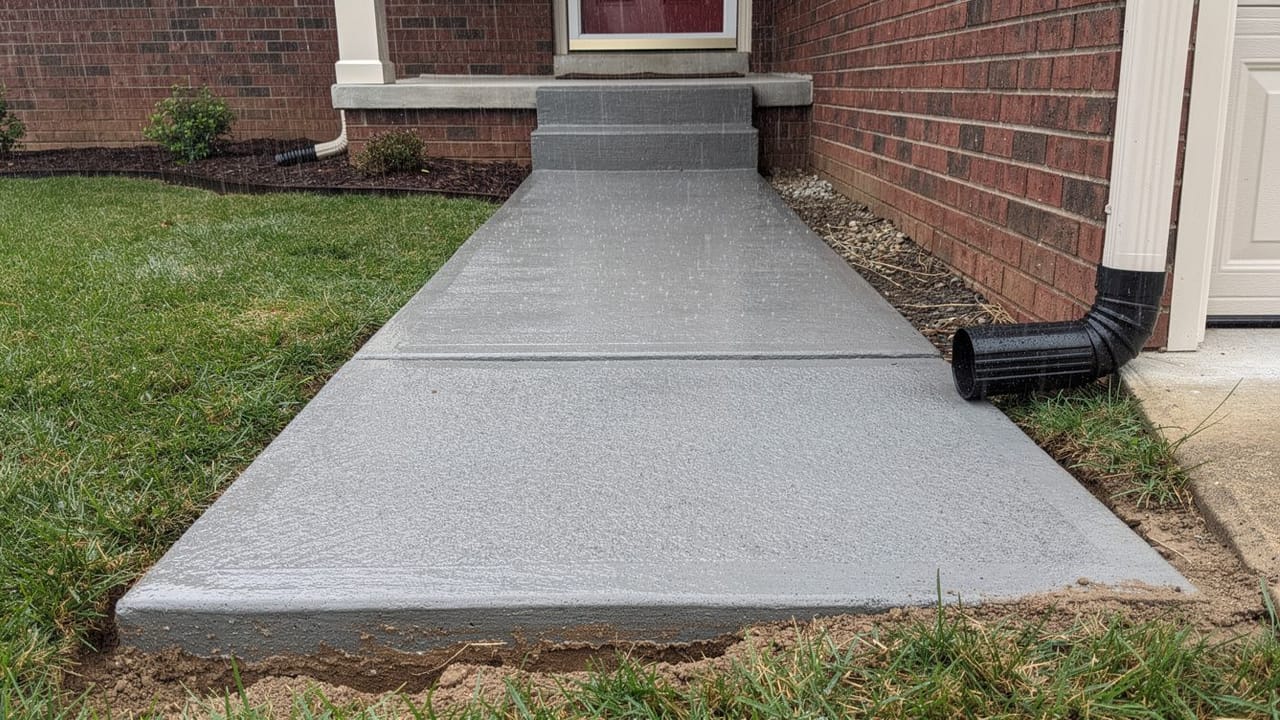
When we find a washed-out base, the first thing we look for is water: a downspout discharging beside the slab, a gutter overflowing above it, or grading that sends runoff underneath. The EPA’s Soak Up the Rain page on redirecting downspouts notes that downspouts are often aimed onto a paved surface such as a driveway, and recommends turning them toward a lawn, garden or rain barrel instead, with a caution to think about where the water will end up so it does not cause damage somewhere else. Illinois Extension’s landscape drainage guide describes the other half of it, rain dislodging soil particles that then travel with the runoff, and asks the same first question we do: can the downspouts be rerouted?
So we ask where the water goes before we quote a lift, and the quote covers moving it. If your walk or driveway has dropped, send us a few photos taken after a rain for a free estimate, and we will tell you whether it can be lifted or should be poured again.
Sources
- Missouri DOT Engineering Policy Guide, 570.5 Mudjacking (Slab Jacking) by MoDOT Maintenance — Injecting grout or polyurethane to fill voids and raise slabs; hole sizes; grout recipe; hydrophobic foam; quarter-inch lift limit; voids from pumping and settlement; foam reserved for small voids; broken slabs cannot be raised effectively
- Missouri DOT Engineering Policy Guide, Category 625 Slab Stabilization — Undersealing prolongs pavement life; look for voids as the surface dries after heavy rain; a slab in more than two pieces should be replaced; fractured slabs are not slab jacking candidates
- U.S. EPA, Soak Up the Rain: Disconnect / Redirect Downspouts — Downspouts often directed onto pavement such as a driveway; redirect to a lawn, garden or rain barrel; consider where the water goes to avoid damage
- Illinois Extension, Landscape Drainage for Homeowners — Runoff dislodges and carries soil particles; rerouting downspouts as a first step
FAQ
Lifting a Sunken Slab Instead of Replacing It — questions
How long does concrete lifting last?
It depends on whether the cause is corrected. Missouri DOT treats filling the voids under a concrete slab as a preservation treatment that prolongs its life by stopping the slab from moving. If the water that washed out the base is still running under it, the same process can open a new void and the slab can settle again.
Is polyjacking better than mudjacking?
Each has its place. Missouri DOT uses polyurethane through small 9/16- to 3/4-inch holes and specifies a hydrophobic foam that holds up in wet ground, but because of the material cost it reserves foam for raising slabs and filling small voids, not large ones. Cement grout goes in through larger holes and suits bigger voids, though a mix that is too stiff can leave the slab unsupported between holes.
Can a lifted slab be driven on right away?
Ask the installer for the cure time of the material they are using before you drive on it, because it varies by product. Foam and cement grout set in different ways and on different schedules. On a driveway, settle the timing before the work starts so you know when the car can go back in and out.
How do you fix a sunken concrete driveway?
If the panel settled in one sound piece, it can usually be lifted by pumping foam or cement grout under it through small drilled holes. A panel broken into more than two pieces, or one with a crumbling surface, needs replacing instead. Either way, find the water that washed out the base, often a downspout, or the void opens again.