
· by Michael Blair, Nashville's Concrete
Concrete sealer gets sold on a schedule and applied on faith. It does real work in a climate where winter nights drop to freezing over and over, but how often a driveway needs it comes down to the sealer type and the exposure, and the calendar printed on a bucket has little to do with either. On the driveways we pour and repair, the question we get most is how often, so that is where this ends up.
What does sealing a concrete driveway protect against?
Water getting into the concrete and then freezing. Middle Tennessee does not get deep, lasting cold, but the National Weather Service’s Nashville climate normals count about 67 days a year with a low at or below 32 degrees, 50 of them in December, January and February. A 2022 Iowa State University evaluation of penetrating sealers names moisture saturation and chloride from deicing salts as the main things working against concrete durability in Iowa, and finds that putting off the point where the concrete becomes saturated reduces its freeze-thaw exposure. On a driveway we see that damage as scaling, the top surface flaking away. Flaking on a slab only months old can have other causes, which our post on why new concrete dusts, flakes or turns white goes through.
Second is salt. Deicer tracked up the driveway on an icy morning soaks in with the meltwater, and Euclid Chemical’s data sheet for Baracade WB 244, a silane and siloxane penetrating sealer, describes it as a water and chloride barrier, reporting an 89 percent cut in chloride ion content in its NCHRP 244 lab test. Sealer is less help with car fluids than people expect. The data sheet for Euclid’s Increte Crystal Clear VOC, an acrylic cure and seal that lists driveways among its uses, says it is not resistant to gasoline or other automotive fluids, so we still tell people to wipe up an oil drip the day it happens.
The two families of sealer
Penetrating sealers soak in. The Iowa State report notes that most products sold this way are silanes, siloxanes, silicates or siliconates, and that the water repellents among them coat the walls of the pores so the concrete sheds water. Euclid’s label for Baracade WB 244 says it does not alter the appearance or texture of the surface and leaves no gloss, and since nothing builds up on top there is no film to peel. On a plain broom-finished driveway it is what we usually reach for.
Film-forming sealers sit on top. An acrylic like Crystal Clear VOC leaves a clear film that, in the maker’s words, makes stamped and colored concrete look deeper and richer, which is why decorative work usually gets one. The same data sheet warns that heavy applications or too many coats over time can cause bubbling, whitening and peeling, so we recoat a film when it has worn thin and leave it alone until then. What that means on a patio is in our post on what stamped concrete needs to stay looking good.
- Penetrating silane or siloxane: no change in look, an interval measured in years, our usual pick for a plain driveway
- Acrylic film: deeper color and a sheen, recoated as it wears, the usual choice for stamped work
- Epoxy and urethane: floor coatings, and we do not put them on an exterior driveway
- A slab that stays damp from below: we sort out the water before any film goes on it
How do you know when a driveway needs resealing?
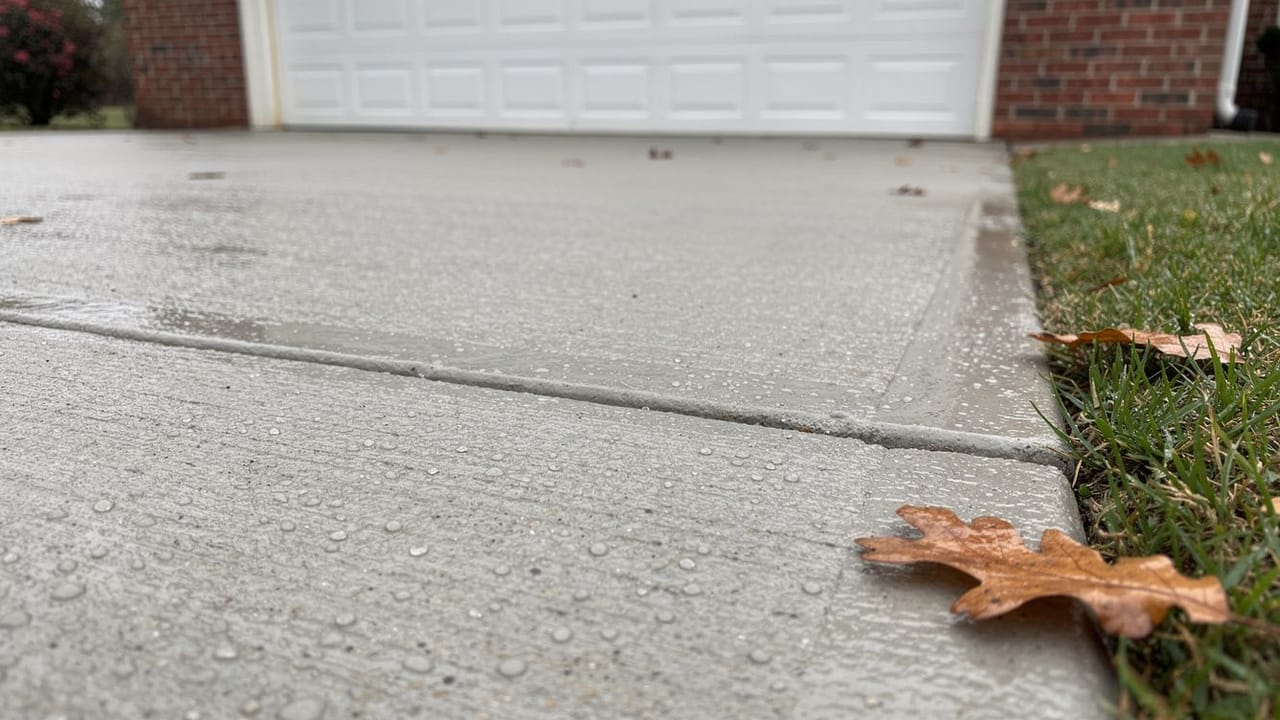
Euclid’s maintenance guide for its penetrating sealers says to reapply when the surface is darkening and absorbing water again or no longer beads it, and that this usually takes at least five years, sometimes longer, depending on weathering, abrasion and chemicals. The test is simple: sprinkle water on the driveway. If it beads, the sealer is working. If it soaks straight in and darkens the concrete, it is time. Bridge decks take far more traffic and salt than a driveway, and even there the Iowa State report cites an Oklahoma study that found no silane sealer failures in the first 12 years.
Film sealers on decorative work are judged by how worn the film looks, and the date on the last invoice tells you little. Resealing a film that has not worn just adds thickness, and the Crystal Clear VOC sheet lists multiple coats over time among the causes of whitening and peeling. It also says best performance and appearance come from two thin coats.
Timing and the mistakes that ruin a job
New concrete needs time before a penetrating sealer goes on. The Baracade WB 244 label asks for at least 7 days of cure, says a longer cure gives better sealer performance, and wants the surface dry for 24 hours beforehand. A cure-and-seal acrylic works the other way around, since it is made to go on freshly placed concrete as its curing compound, so the label on the product in hand is the rule. Both labels say not to apply below 40 degrees or with rain expected within 12 hours, and the acrylic adds no hot, direct sun and nothing above 85 degrees. Around Nashville we find those conditions easiest to hit in autumn and late spring.
The two failures we see are too much sealer and a slab that was dirty or damp when it went on. Both labels want the surface clean, dry and sound first, and the penetrating sealer’s label asks for moving joints and cracks to be sealed with an elastomeric joint sealant before it is sprayed. A film that turned white under a heavy coat gets stripped and redone; Euclid’s removal options for its acrylic are a strong solvent, a citrus stripper or mechanical removal. If yours has reached that point, or you would rather hand the sealing to us, ask us for a free estimate.
Sources
- NOAA National Weather Service Nashville, Nashville Climate Records (BNA) — Normal of 67 days a year with a minimum at or below 32 degrees, 50 of them in December through February
- Iowa State University CP Tech Center, Evaluation of Penetrating Sealers for Concrete (IHRB TR-765, 2022) — Moisture saturation and deicing-salt chloride as main durability factors; penetrating sealer types; Oklahoma bridge-deck silane study
- Euclid Chemical, Baracade WB 244 Technical Data Sheet (Rev. 03.24) — Silane/siloxane water and chloride barrier; no change in appearance, no gloss; 7-day cure, 24 hours dry, 40 degrees, 12-hour rain rule; joint sealing; garden sprayer on small jobs
- Euclid Chemical, Penetrating Water Repellent Sealer Maintenance Procedures — Reapply when the surface darkens or stops beading water; usually at least 5 years
- Euclid Chemical, Increte Crystal Clear VOC Technical Data Sheet (Rev. 07.24) — Acrylic film for stamped and colored concrete; whitening and peeling from heavy or repeated coats; two thin coats; not resistant to automotive fluids; 85-degree and sun limits; removal; professional use only
FAQ
Sealing a Concrete Driveway and How Often — questions
How often should a concrete driveway be sealed in Nashville?
With a penetrating sealer, every few years rather than annually; one maker’s guide says reapplication is usually not needed for at least five years, and the water bead test tells you when. Decorative or stamped concrete with an acrylic film sealer is recoated when the film wears. A fixed yearly schedule is more often than a penetrating sealer needs.
Does sealing stop concrete from cracking?
No. A sealer is a water and salt repellent, and none of the sealer labels we work from claims it prevents cracks. What it does is slow the surface damage that comes from water and deicing salt getting into the pores. A cracking slab needs the cause found, not a coating.
Can I seal a driveway myself?
A penetrating sealer on clean, dry concrete is a reasonable homeowner job if the label allows it. The penetrating sealer we cite prefers an airless sprayer but accepts a garden sprayer on smaller jobs, and the main risk is putting down too much, since it is meant to soak in with no build-up. Film sealers are less forgiving: the acrylic data sheet says common garden sprayers should not be used and the product is for professional use only, and lap marks and over-application show and have to be stripped.
What does sealing a driveway do?
It keeps water and deicing salt from soaking into the concrete. Nashville averages about 67 nights a year at or under freezing, and concrete that freezes while saturated is what scales. A penetrating silane or siloxane does this without changing the look, while an acrylic film also deepens color but does not resist car fluids, its maker says.