
· by Michael Blair, Nashville's Concrete
Concrete does not dry, it cures. The Federal Highway Administration’s tech brief on curing concrete describes a hydration reaction that keeps going as long as water is available and the temperature stays high enough to support it. Middle Tennessee pushes on both of those: the National Weather Service’s Nashville climate records put the normal July high at 90.9°F and the normal January low at 30.1°F, with 19 January days at or below freezing on average. Whether it is a driveway or a patio, a pour at either end of the year needs a plan for the weather before the truck is ordered.
Hot weather
Heat speeds the reaction up. Tennessee’s road and bridge specification tells crews pouring in hot weather to guard against an increased rate of cement hydration and high concrete temperatures, and it rejects concrete hotter than 90°F at the point of discharge. Nashville’s normal July high is already above that number. On a hot day the temptation is to add water at the truck so a stiffening load stays easy to work. The same book reaches for a water-reducing admixture when more slump is needed and turns away concrete outside its slump limits, and we do not add water on site to make finishing easier.
Fast surface drying is the other summer risk. The FHWA brief ties plastic shrinkage cracking to the point where evaporation exceeds the rate of bleeding, and it gives 0.20 lb/ft² per hour as a common value for the critical evaporation rate. Fogging is what it calls the most effective way to slow evaporation; evaporation reducers, sprayed as a film on the bleed water, are the other tool, and they are not to be worked into the surface as a finishing aid. How to tell a surface crack from one that matters is in our post on which concrete cracks matter.
Cold weather
Cold works the other way. Tennessee’s specification has crews stop mixing and placing when the falling air temperature in the shade reaches 40°F, keeps freeze protection on for no less than five days, and calls for concrete damaged by freezing to be removed and replaced. Middle Tennessee winter pours are workable, but the protection has to be on site before the first load arrives.
Below 35°F the same book calls for insulation blankets or some kind of housing, holding the air around the concrete at 45°F or more for 120 hours. It also says not to place concrete on frozen grade, and we will not pour on frozen ground whatever protection goes on afterward.
- Very hot: fogging or an evaporation reducer, no water added at the truck
- Very cold: blankets or an enclosure, never on frozen ground
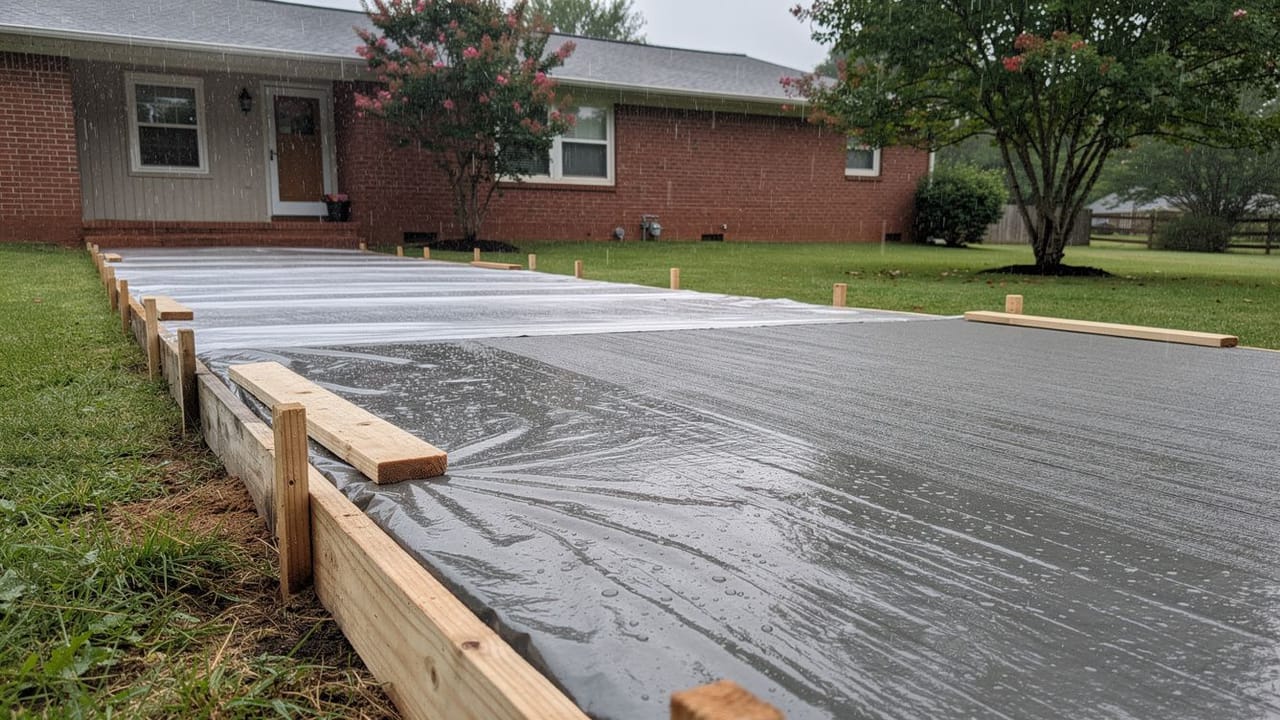
- Rain before it sets: cover it, do not work the water into the surface
- Windy: wind, heat and low humidity together speed surface drying
Should concrete be finished in the rain?
Rain on a slab that has not set arrives while it is still being finished, so we stop and cover it rather than finish through the water. Finishing pressure already brings water to the surface, as the FHWA brief notes, and we do not trowel standing rainwater in on top of that. What a weak, powdery top looks like a season later is in our post on why new concrete dusts, flakes or turns white.
Once the slab has set, keeping it wet is the whole point of curing. The FHWA brief names wet coverings and water spraying as the most effective curing methods, which is why a shower on a slab that has already set worries us far less than one before it sets.
What does curing concrete actually mean?
Curing is the stretch after finishing when the slab is kept wet and warm enough to go on hydrating. The FHWA brief says it should begin when the surface starts to dry, as evaporation overtakes bleeding, and warns that improper curing can result in inadequate hydration and reduced concrete strength. Tennessee’s specification keeps a water cure going for 120 hours, five full days, on the concrete it governs.
Curing compound, plastic sheeting or wet burlap all do the job, and the FHWA brief recommends a white-pigmented curing compound on hot, sunny days. Ask what the curing plan is before anyone pours; a contractor who has an answer is telling you something useful about the rest of their work. If you want ours for your slab, ask us for a free estimate and we will go through it with you.
Sources
- Federal Highway Administration, Curing Concrete Paving Mixtures (Tech Brief FHWA-HIF-18-015, 2018) — Hydration needs water and temperature; plastic shrinkage when evaporation exceeds bleeding; 0.20 lb/ft²/hr critical rate; fogging and evaporation reducers; finishing brings water up; wet coverings and spraying most effective; when curing begins; reduced strength from improper curing; white-pigmented compound on hot days
- Tennessee Department of Transportation, Standard Specifications for Road and Bridge Construction (2021), Sections 501 and 604 — Hot-weather hydration and 90°F discharge limit; water-reducing admixture for slump; stop at 40°F falling; blankets or housing below 35°F, 45°F for 120 hours; 5-day freeze protection; remove freeze-damaged concrete; no placing on frozen grade; 120-hour water cure; 28-day cylinders
- National Weather Service Nashville, Climate Records (BNA) — July normal high 90.9°F; January normal low 30.1°F; 19 January days at or below 32°F
FAQ
Weather That Ruins a Concrete Pour — questions
How long before I can walk on new concrete?
It depends on the mix and the weather, and cold weather stretches every wait, so we give you the walk-on and drive-on times for your own slab on the day we finish it. The 28-day figure you may hear is the age at which test cylinders are checked against the design strength in specifications such as Tennessee’s road book. It is a testing age, not a walk-on time.
Is it bad if it rains right after a pour?
It depends on timing. Before the slab has set, we cover it and hold off finishing rather than work the water in. After it has set, water on the surface is part of curing; the FHWA names wet coverings and water spraying as the most effective curing methods. The thing to avoid is troweling rainwater into a fresh surface.
Can concrete be poured in a Nashville winter?
Yes, with precautions. The ground must not be frozen, and below 35°F Tennessee’s road specification calls for insulation blankets or an enclosure that keeps the air around the concrete at 45°F or more for 120 hours. The same specification calls for concrete damaged by freezing to be removed and replaced, which is why the protection is planned before the pour.
Should I cover concrete after pouring?
In most weather, yes. Wet burlap, plastic sheeting or a sprayed curing compound keeps the slab moist so it goes on curing, and the FHWA counts wet coverings among the most effective methods. In cold weather the slab also needs insulation blankets, and if rain comes before it sets, we cover it and stop finishing.