
· by Michael Blair, Nashville's Concrete
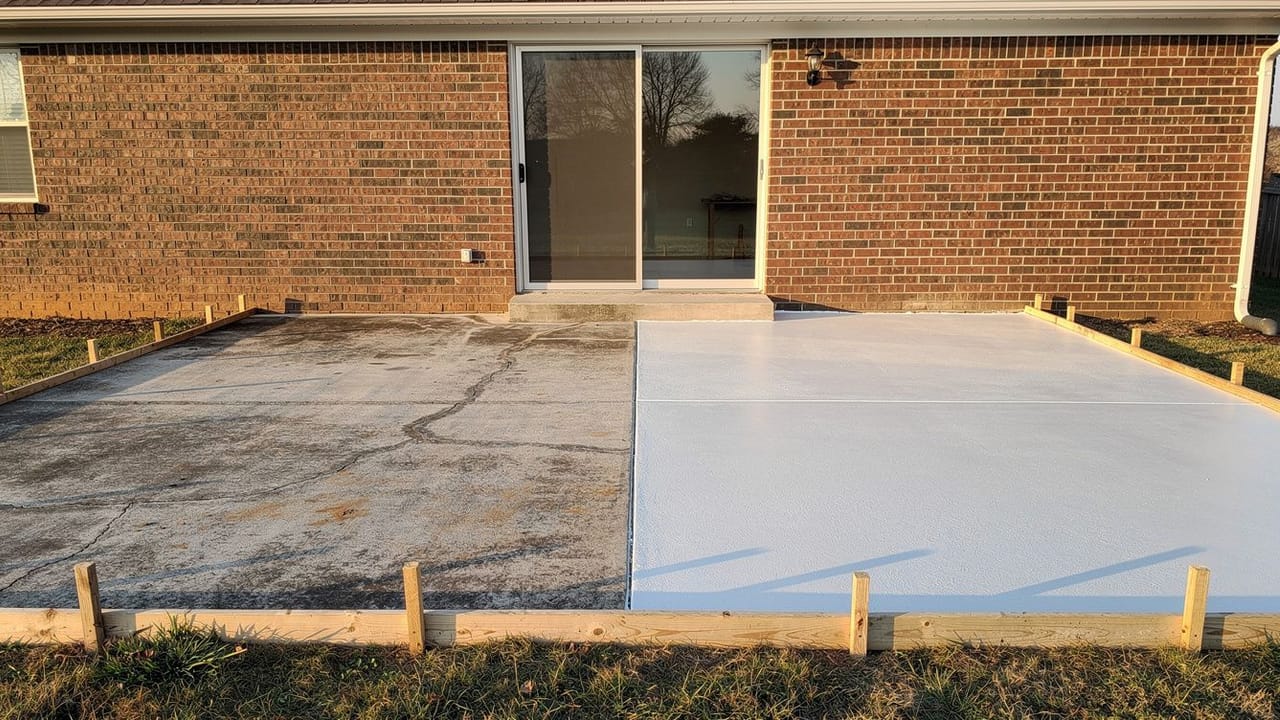
Pouring over an old slab instead of breaking it out is one of the first things people ask about when a driveway or patio looks tired. Sometimes it is the right call. Often the old concrete is telling you something a new layer will not fix.
The best guidance in print comes from road work, where concrete overlays have been studied for decades, and from the makers of thin resurfacing products. Both say the same few things, and they apply at the scale of a driveway in our concrete repair and replacement work as much as on a highway.
Can you pour concrete over existing concrete?
Yes, new concrete can go over old when the old slab is sound and the extra height will not cause trouble at a door, a garage or the street. There are two ways to do it, and they behave differently. In a bonded overlay, the old surface is roughened and cleaned so the new layer grips it, and the CP Tech Center’s Guide to Concrete Overlays at Iowa State explains that bonded layers then act as one. In an unbonded overlay, a separation layer keeps the two apart, and each bends on its own.
That guide calls for the separation layer under an unbonded overlay to be asphalt at least an inch thick or a geotextile fabric, so the old cracks do not carry up. Its thickness figures are for pavements, not houses. What carries over to a patio is the logic: a thin bonded layer is only as good as the slab under it, and a thicker separated one costs height a house rarely has to spare.
What does the old slab have to be like?
The old slab has to be solid, sitting on a base that is not moving, and already draining the right way. The Iowa State guide reserves a bonded overlay for pavement in good structural condition, and it lists poor support underneath or poor drainage as reasons not to use one at all. It also says plainly that an overlay by itself will not solve a drainage problem.
On Middle Tennessee clay, a slab that has sunk at one corner or tilts toward the house has a base problem, and a new layer would follow the old one down. That slab may need concrete leveling first, or removal.
Surface preparation is the other half. The Quikrete Concrete Resurfacer data sheet describes its product as a thin-layer repair for existing sound concrete, has badly damaged areas repaired and cured before it goes on, and calls cleaning with a 3,500 psi pressure washer essential to the bond. It also limits the product to bare concrete, never a painted or sealed surface.
Will the old cracks come back through the new concrete?
Old cracks often come back, because anything that moves in the slab below moves the layer on top of it. The Quikrete sheet warns that no method fully keeps old cracks out of the new surface, above all where the old slab lacks adequate control joints or has settled, and that movement in the base concrete can bring them back. A crack that opens and closes with the seasons will keep doing so under new material.
Joints are the part people skip. The same sheet keeps existing control joints and has old expansion joints retained and built up to the new height. For bonded overlays, the TxDOT Pavement Manual has the new joints sawn directly over the existing ones so the old joints do not crack through, and the Iowa State guide pictures the double crack that forms when the two miss. Where the joints on an old patio were placed badly to begin with, our post on where control joints go explains why that alone can argue for starting over.
Where the added height causes trouble
Height is what most often rules out a new layer at a house. The Iowa State guide counts limits on raising the surface, such as curbs and driveways that have to meet it, among the reasons an overlay is not recommended, and a house has more of those edges than a road does: the garage floor, the step at the back door, the street apron, the bottom of the siding. Every inch added has to be planned for at each one.
Drainage still has to work after the pour. Section R401.3 of the 2024 residential code as Nashville adopted it requires hard surfaces within 10 feet of the foundation to slope at least 2 percent away from the building, and a raised patio has to keep that fall. When we look at a slab for an overlay, we measure the height at every door and edge it meets before we talk about thickness.
If the old concrete is sound and the numbers work, an overlay can spare a tear-out. If not, a new driveway or patio is the better investment. Send us photos and a few measurements, and we will tell you which one yours is.
Sources
- National Concrete Pavement Technology Center, Iowa State University, Guide to Concrete Overlays, 4th edition (2021) — Bonded layers act as one, unbonded layers bend separately; separation layer of 1 in. asphalt minimum or geotextile; bonded overlays typically 2 to 6 in. on pavement in good structural condition; not recommended with poor support or drainage or limits on raising the profile; an overlay alone will not solve drainage; mismatched joints cause a double crack
- Quikrete, Concrete Resurfacer No. 1131 data sheet — For existing sound concrete; 3,500 psi pressure washing essential to the bond; reflective cracking cannot be completely prevented; control and expansion joints maintained; bare concrete only, not painted or sealed; built up in 1/8 in. layers
- Texas Department of Transportation, Pavement Manual, Bonded Concrete Overlay procedures — Overlay joints sawn directly over existing joints to prevent reflective cracking
- International Residential Code 2024 as adopted by Metro Nashville, Section R401.3 Drainage — Hard surfaces within 10 feet of the foundation sloped at least 2 percent away from the building
FAQ
Pouring Concrete Over Existing Concrete — questions
Does pouring new concrete over old fix drainage?
No. The CP Tech Center’s Guide to Concrete Overlays says an overlay alone will not solve drainage problems, and it lists poor drainage as a reason not to use one. A slab that tilts toward the house needs its slope corrected, by lifting it or replacing it, before any new surface goes on.
Do joints in a concrete overlay have to line up with the old ones?
Yes. The TxDOT Pavement Manual has joints in a bonded overlay sawn directly over the existing joints to keep them from cracking through, and the Iowa State overlay guide shows the double crack that forms when they miss. Quikrete’s resurfacer sheet also carries existing control and expansion joints up through the new layer.
Will a resurfacer stick to painted or sealed concrete?
Not reliably. Quikrete’s Concrete Resurfacer data sheet says to apply it only to bare concrete and never to painted or sealed surfaces, and it calls cleaning with a 3,500 psi pressure washer essential for a proper bond. Paint and sealer have to come off before a cement-based topping goes on.
Can new concrete go over cracked concrete?
It can, but the cracks will likely return. Quikrete’s data sheet says old cracks cannot be fully kept from reflecting into a new surface, above all where the slab lacks adequate control joints or has settled. Cracks that keep opening, or have one side higher than the other, mean the base under them is moving.
How thin can a concrete overlay be?
Cement-based resurfacers go on very thin: Quikrete’s data sheet builds thicker applications in layers of about an eighth of an inch and needs no forms below that. Bonded concrete overlays on roads typically run 2 to 6 inches, per the Iowa State overlay guide. The right thickness depends on the slab and on the height available.